
Weber Carburetor Repair for Vintage Performance Engines
Vintage performance parts are becoming harder to replace. Owners of classic Volkswagen, Porches, Fiats, and Ford performance cars often spend years searching for original components. When one of those parts breaks, finding a replacement can be expensive, time consuming, or impossible. That challenge becomes even greater when the damaged component is a vintage Weber carburetor.
A Muggy Weld customer recently faced that situation when a Weber IDF carburetor developed both a crack and a hole. Instead of searching for a replacement, he repaired the original carburetor and returned it to service.
Why Weber Carburetors Matter
Few carburetors enjoy the reputation of a Weber. The Weber IDF was originally developed in Italy and became a favorite among racers because of its performance and tuning flexibility. Over time, these carburetors found their way onto a wide range of vehicles.
Popular Applications for Weber IDF Carburetors
Weber IDF carburetors have been used extensively on:
- Porsche engines
- Volkswagen Beetles
- Volkswagen Campervans
- Fiat Twin Cam engines
- Ford Escort RS2000 models
Today, many enthusiasts continue to use Weber conversion kits to upgrade older factory carburetors. Because many of these carburetors are no longer easy to replace, repair often becomes the preferred option.
A Customer Restores a Damaged Weber IDF
The featured repair came from customer Ernesto, who shared photos and feedback after restoring his damaged carburetor. According to his testimonial, he successfully repaired both a crack and a hole in the casting. He was also able to tap a new thread and return the carburetor to service. Ernesto described the repair kit as “a lifeline for the vintage auto enthusiast.”
His experience highlights a common reality in classic vehicle restoration. Original parts often deserve repair rather than replacement.
Understanding the Carburetor Material
The Weber IDF carburetor featured in the repair is zinc based. Zinc die cast and other white metals behave differently than steel or aluminum.
Zinc Melts Quickly
Zinc die cast reaches its melting point at approximately 730°F.
There Is Little Warning Before Melting
Unlike some metals that change color as they heat, zinc and white metals provide few visual indicators before reaching their melting point. That characteristic makes temperature control especially important during repair.
Preparing a Weber Carburetor for Repair
Successful repairs begin with careful preparation.
Remove Fuel and Flammable Liquids
Any remaining fuel or flammable residue should be removed before heating begins.
Clean the Damaged Area Thoroughly
Oxidation, grease, oil, and contamination can interfere with bonding. The repair area should be cleaned completely before soldering.
Prepare the Damaged Threaded Hole
In the demonstration, the damaged threaded hole was drilled slightly larger before the repair process began. Proper preparation helps create a stronger finished repair.
Heating the Carburetor Correctly
Heat control is one of the most important parts of pot metal and zinc repair.
Bring the Parent Metal to Temperature
Broadly heat the carburetor body until it reaches approximately 350°F. Heating from multiple angles helps distribute heat evenly throughout the repair area.
Alternate Preheating Methods
Some users have reported preheating zinc castings in an oven before soldering. This approach can help bring larger castings closer to working temperature before torch work begins.
The featured carburetor required relatively little preheating because there was not a large amount of material surrounding the damaged area.
Using Flux as a Temperature Guide
One challenge with zinc repair is knowing when the metal is ready for filler material.
Apply Flux First
After the carburetor reached temperature, the repair rod was dipped into the flux and the flux was applied to the repair area.
Watch for the Visual Indicators
The liquid flux acts as a built-in temperature guide. When the flux begins to bubble and turn brown, the casting has reached the proper temperature for applying the filler rod.
This visual cue helps reduce the risk of overheating the zinc casting.
Restoring Rare Parts Instead of Replacing Them
Many classic car owners spend years searching for original components. When a rare carburetor develops a crack, stripped thread, or missing section, replacement may not be practical. Repairing the original part preserves authenticity while often saving significant time and expense.
The Weber IDF carburetor featured in this project demonstrates how low-temperature repair techniques can restore valuable vintage components that might otherwise be discarded.
Final Thoughts
Vintage carburetors are more than mechanical parts. They are pieces of automotive history. The successful Weber carburetor repair completed by Ernesto shows how damaged zinc castings can often be repaired rather than replaced. By cleaning the metal thoroughly, controlling heat carefully, and using flux as a temperature guide, cracks, holes, and damaged threaded areas can be restored with confidence.
For enthusiasts restoring classic performance vehicles, preserving original parts often makes the finished project that much more rewarding.
Disclaimers:
Please visit https://www.aws.org/Standards-and-Publications/Free-Resources/#YourResources prior to using our welding products, and adhere to all AWS welding safety guidelines.
Further product safety information is available at https://muggyweld.com/safety-guidelines
Muggy Weld LLC shall not be liable for any loss, injury, claim, liability, or damage of any kind resulting in any way from (a) your use of this Site, (b) any services or products obtained from this Site, (c) any errors in or omissions from this Site, (d) the unavailability or interruption of this Site or any features thereof, (e) any content contained on this Site.
MSDS sheets available with purchase from MuggyWeld.com, upon request.
Updated 9/10/26
Check Out These Products
-
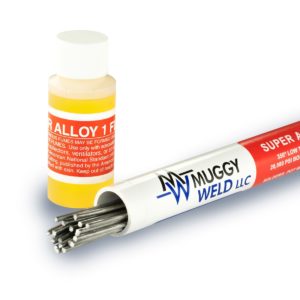
Super Alloy 1 Low-Temperature Solder
Price range: $55.00 through $980.00350º F multi-metal solder joins pot metal and all white metals, in any combination🌡 Melting Temperature 350 / 177 ⇄︎ Bonding Strength 20000 psi, 137.89 MPa -
Sale!
Super Alloy 5 Aluminum Welding and Brazing Rod
Price range: $48.30 through $686.00600°F aluminum welding, brazing, and soldering rod. Ideal for aluminum boat repair and cast aluminum.🌡 Melting Temperature 600 / 317 ⇄︎ Bonding Strength 30000 psi, 206.84 MPa -

SSF-6 Silver Solder Rod: Flux-Coated SSF-6 56% Brazing Rod
Price range: $135.00 through $3,000.00High-Strength, 56% Silver Solder Rod🌡 Melting Temperature 1150 / 621 ⇄︎ Bonding Strength 70000 psi, 482.63 MPa 🔧︎ Sizes Available (in) 1/16 🔧︎ Sizes Available (mm) 1.58